
SM Waqas Imam is a qualified industrial engineer. His experience of around a decade of working with four different manufacturing concerns has helped him to critically understand the dynamics of different types of organizations. He is also c

By the end of this course, you will be able to:
- Describe how ISO 9001 helps auditors. Explain basic auditing terminology
- Describe different types of audits
- Describe the process of conducting an audit
- Describe how non-conformance to requirements is reported
- Summarize the attributes of successful auditors
- Explain how to prove general principles of auditing
- Explain how audit requirements vary with different management systems
- Summarize the expectations of clients from audits
- Outline how audit findings are followed-up

By the end of this course, you will be able to:
- Summarize the systems involved in OH&SMS
- Explain who is responsible for developing the ISO 45001 standard
- Illustrate the timeline involved in the development of ISO 45001
- Discuss the compatibility of ISO 45001 with other standards
- Describe the timeline involved for migrating to ISO 45001
- List the benefits ISO 45001 can yield to businesses
- Outline the benefits ISO 45001 yields to managers and professionals
- List the expectations top management has in a OH&SMS
- Describe how best to manage health and safety risks
- Explain how support functions affect an organization's performance
- Define what operational controls are
- Explain the OH&SMS standard and the fundamental concepts and terminology it uses

By the end of this course, you will be able to:
- Explain the need for an Environmental Management System (EMS).
- Discuss the fundamental concepts used in Environmental Management Systems (EMS).
- Define the key terminology used in Environmental Management Systems (EMS).
- Identify the organization responsible for developing the ISO 14001:2026 standard.
- List the benefits of ISO 14001 for organizations.
- Outline the benefits of ISO 14001 for stakeholders.
- Summarize the expectations placed on top management in an Environmental Management System (EMS).

By the end of this course, you will be able to:
- Identify the differences between ISO 22000:2018 and ISO 22000:2005
- List the requirements of the standard
- Define the Context of food organizations
- Discuss how is the PDCA approach valid at two levels in the standard
- Recall the Main Clauses of ISO 22000:2018
- Describe the Operation Controls of FSMS
- Identify the elements of food safety internal audits and management reviews

By the end of this course, you will be able to:

- Compare the revision of ISO 13485:2003 to ISO 13485:2016
- List the main clauses of the ISO 13485:2016 standard along with the requirements
- Define important terminologies about medical devices as per ISO 13485:2016
- Explain the purpose of other international and regulatory standards like ISO 14971 and FDA 21 CFR Part 820
- Compare ISO 13485 with FDA 21 CFR Part 820
- Describe how to manage the requirements about medical device files
- Illustrate how to assimilate work environment and contamination control requirements
- Describe how to manage the requirements about design and development

By the end of this course, you will be able to:
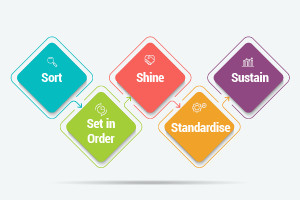
- Outline the historical development of ‘5S’ concepts and methods
- Explain what concerns to address before implementing Kaizen philosophies
- Describe how to implement each ‘S’
- State the importance of this implementation programme
- List the steps for ‘Gemba Walk’ in ‘5S’
- Outline the importance of this programme for maintaining safety and standards like ‘ISO 9001’ and ‘ISO 45001’

By the end of this course, you will be able to:
- Define ‘Kaizen’ and lay out its philosophy and methods
- List the attributes of successful Kaizen events
- Discuss the ‘three Ms’: muri, mura and muda
- Explain the role of ‘plan-do-check-act’ (PDCA) and ‘standardize-do-check-act’ (SDCA) methods
- Explain ‘Gemba Kaizen’ and role of management
- List the seven-step process for Kaizen implementation
- Describe the elements of Kaizen events
- Compare the concepts of ‘continual’ and ‘continuous’ improvement
- Discuss the responsibility of monitoring Kaizen events
- Identify how to navigate Kaizen’s cycles and systems
- Outline the development of Kaizen stories and their themes

By the end of this course, you will be able to:
- Compare the revision of ISO 50001:2011 to ISO 50001:2018
- List the main clauses of the ISO 50001:2018 standard and its requirements
- Define important terminologies about EnMS as per ISO 50001
- Explain the purpose of Energy measurement and information system and its relation with the energy management system
- Analyze organization's context as per the ISO 50001:2018
- Describe the role of leadership in ISO 50001 and how to manage the requirements of leadership
- Differentiate between energy baseline and performance indicators
- Describe how to manage the requirements for the design of facilities and equipment
- Explain the particular requirements of the procurement process for an EnMS
- Express the idea of risks and opportunities for an EnMS
- Define Energy Review and Energy AuditDifferential Energy Audit and the Audit for an EnMS


Frequently Asked Questions
Once you have completed your purchase, your Digital Certificate/Digital Diploma and Transcript can be downloaded from the Dashboard of your Alison Account.
I access Alison via my computer:
Expand the Your Completed Courses & Claimed Certificates widget in your dashboard as shown below:
You will then be able to download your Digital Certificate/Diploma and Transcript. 
I access Alison via my Mobile Browser:
Expand the Your Completed Courses & Claimed Certificates widget in your Dashboard as shown below:
You will then be able to download your Digital Certificate/Diploma and Transcript. 
I access Alison via App:
Open My Certificates in your Dashboard, as shown in the example below:

You will then be able to download your Digital Certificate/Diploma and Transcript.

Continuing Professional Development, or CPD, is the process of continually developing or maintaining your professional skills. CPD helps individuals focus on how they can become a more competent and effective professional. Due to our rigorous publishing review process, courses on Alison are now being accredited by CPD UK, an independent organisation. Accredited CPD training means the learning activity has reached the required Continuing Professional Development standards and benchmarks, and the learning value has been scrutinised to ensure integrity and quality. This CPD Certification Service provides recognised independent CPD accreditation compatible with global CPD requirements. This means a certificate from a course on Alison can now be used as part of your CPD requirements (please check with your organisation’s guidelines). You can find out more about Alison accreditation here.
Users can pay a nominal fee to automatically download Digital Certificates or purchase paper or framed Certificates that are shipped via mail. For a more detailed list of the costs, visit the Shop page.