





GALWAY, IRELAND - 2026-09-16
Alison, the world’s largest free online empowerment platform, has announced that it will adopt the Equal Earth map projection across its general-purpose world maps, supporting a global move towards representing Africa and other regions more proportionately.
The decision follows the United Nations General Assembly’s adoption of the ‘Correct the Map’ resolution on 4 September 2026. Led by Togo and the African Union, the resolution was backed by 164 countries and encourages governments, schools, international organisations, and technology companies to use Equal Earth and other equal-area projections when the relative size of continents matters.
Alison will use Equal Earth maps in its marketing materials and new course content where appropriate. The Mercator projection will continue to be used in learning contexts where its particular properties are important, including navigation and geographical studies involving longitude, latitude, or direction.
The World Map Many Know Distorts Its True Proportions
Developed by Gerardus Mercator in 1569, the Mercator projection was created to solve a practical problem for sailors. By preserving direction, it allowed navigators to plot straight courses across a flat map.
That advantage comes with a significant trade-off. The projection increasingly enlarges landmasses farther from the Equator, meaning the relative sizes of continents and countries can look very different from their actual areas.
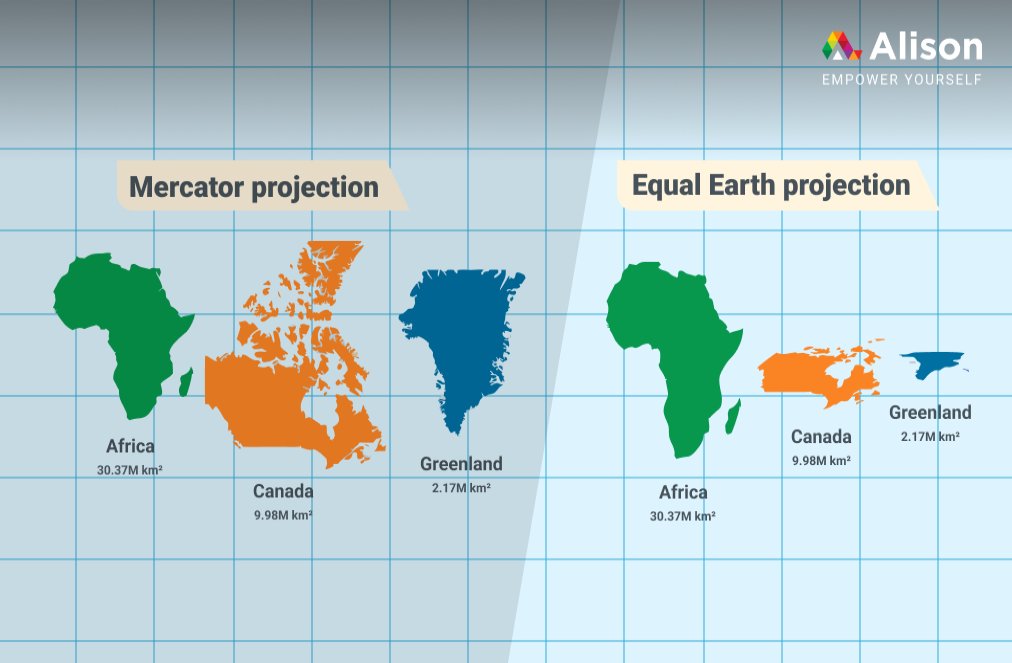
The effect is particularly striking when comparing Africa and Greenland. On a Mercator world map, the two can appear relatively similar in size. In reality, Africa is approximately 14 times larger than Greenland.
Equal Earth, developed in 2018, takes a different approach. As an equal-area projection, it preserves the relative size of regions, providing a more proportionate representation of Africa and the rest of the world.
An African-Led Campaign Put Map Representation on the Global Agenda
The UN decision follows the African Union’s support for the ‘Correct the Map’ initiative, which has argued that the widespread use of Mercator beyond its original navigational purpose has influenced how generations have perceived the relative scale of Africa.
In February 2026, the African Union adopted Equal Earth and urged Member States to revise national curricula accordingly. The subsequent UN resolution took the issue to a global level, specifically encouraging educational institutions, media organisations, publishers, and technology platforms to consider map projections that better represent relative areas.
For Alison, which provides learning to millions of people around the world, that educational context makes the decision particularly relevant. Maps do more than help Learners locate places. They also shape an understanding of how those places relate to one another.
Choosing the Right Map for What Learners Need to Understand
The move does not mean removing Mercator wherever it appears. No flat map can perfectly represent a spherical planet, and different projections are designed to preserve different geographical properties.
Mercator remains valuable for purposes such as navigation, where maintaining direction is important. Alison will therefore continue using it in courses where those properties are necessary to what is being taught.
For general representations of the world, however, Alison will favour Equal Earth, allowing Learners to see continents in proportions that more closely reflect their actual areas.
The distinction reflects a simple principle behind Alison’s decision: educational materials should use the representation best suited to what they are trying to teach. When the purpose is to understand the relative size of the world’s regions, Africa should look as large as it actually is.
Ends
About Alison
Alison is a global leader in free online learning and skills development. With over 50 million registered Learners across 193 countries (as of October 2025), Alison empowers individuals, communities, and organisations to upskill quickly and effectively – at zero cost.
The Alison platform provides immediate access to over 6,000 free, CPD-accredited courses, covering essential areas such as Artificial Intelligence, Data Science, Cybersecurity, Digital Marketing, Project Management, Business Operations, Healthcare and Sustainability. Courses are created by a mix of independent experts and global leaders, including IBM, Stanford and Microsoft.
For organisations, Alison offers a Free Learning Management System (LMS) that enables unlimited Learners to access thousands of courses with no upfront cost. A premium version with advanced analytics and customisation is also available. Alison's offering includes a full suite of assessments and psychometric tools, including a Workplace Personality Assessment, Mental Health & Wellbeing Assessment, English Language Proficiency Test, as well as Numerical, Verbal, and Abstract Reasoning tests.
To further support career development, Learners also gain access to a Career Guide, a Resumé Builder, and the ability to study offline through the Alison App.
The platform is also expanding its reach with multilingual versions, starting with complete Spanish, French, and Hindi offerings — reaffirming its mission to make education accessible to anyone, anywhere.
Founded in 2007, Alison pioneered the concept of free, large-scale online learning and is recognised as the world’s first MOOC (Massive Open Online Course) platform. Today, its mission continues: to break down barriers to learning, helping people gain skills, build confidence, and improve their lives — no matter where they live or what they earn.
Find us on Facebook, X, LinkedIn, Instagram, and YouTube.