
With a major in education and science, Elshenawy helps others comprehend the subtlety of the Arabic and Portuguese languages by enriching their vocabulary and improving the grammatical skills required to have a fluent conversation.
Escola disseminates its knowledge and expertise in various languages. Learners can enrich their skills with the help of resourceful teachers, translators and voice-over artists.

By the end of this course you will be able to:
- Differentiate between regular verbs and irregular verbs
- Categorize the different tenses used according to their sentences
- Recall the various conjugations of the verbs in the different tenses
- Discuss the methods of negating a verb
- Outline the process of asking questions using the norms of the relevant tenses
- Distinguish between the various uses of the relevant tenses
- State the procedure for locating the single words
- Translate grammatically correct sentences
- Recognize when the auxiliary is used in conjunction with the infinitive

By the end of this course, you will be able to:

- Identify the Brazilian pronunciation of specific letters in Portuguese
- Indicate the commonly used Portuguese words and phrases
- Explain how you express yourself in Portuguese when meeting new people
- Describe the process of negating a sentence
- Differentiate between regular and irregular verb conjugation rules
- Summarise the various types of Portuguese nouns
- Outline the most important aspects of learning Portuguese

By the end of this course, you will be able to:

- Describe how to ask for directions and locations
- Recognise the Portuguese terms for prominent tourist attractions in a city
- State commonly used Portuguese salutations
- Identify how to express hunger and thirst
- Distinguish the gender categorisation of most Portuguese nouns
- Recall numbers zero to one hundred with correct Portuguese pronunciations
- Explain the basic phrases relating to monetary conversations
- Outline the fundamental terminology related to food and beverages
- Discuss the price of food and drink when ordering

By the end of this course, you will be able to:

- Describe how to enquire about time-related matters
- Outline the Portuguese terms for different countries and nationalities
- Recognise the grammatically correct use of verbs in sentences
- State commonly used Portuguese phrases and words
- Identify the classification of the gender of Portuguese words and countries
- Recognise how to pronounce certain letters based on their location
- Recall the use of gender-specific names and nationalities
- Explain how to carry out personal conversations in Portuguese
- Identify the common Portuguese words and phrases used in personal conversations

By the end of this course, you will be able to:

- Describe how to express health-related matters
- Distinguish the Portuguese words for various male and female job titles with correct pronunciations
- Recognize the grammatically correct use of verbs in sentences
- State commonly used Portuguese phrases and words
- Distinguish the classification of the gender of Portuguese words
- Identify the pronunciation of specific letters based on their location in a Portuguese word
- Recall the use of gender-specific family titles

By the end of this course, you will be able to:
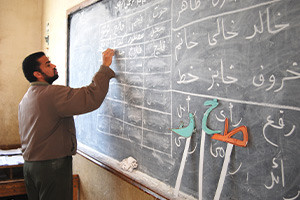
- Recognize the basic Arabic letters
- Describe how to write Arabic letters
- Explain how to pronounce Arabic letters correctly
- Identify the signs in the Arabic alphabet
- Indicate the concept of Tashkil
- Discuss the purpose of the short and the long vowels
- Outline the notions of Secoon, Shadah and Tanween
- Discuss when and how to use the letter Alef
- Explain how to write the letter Alef based on its position in the word

By the end of this course, you will be able to:

- Describe how to ask questions and construct sentences relating to time
- State grammatically correct phrases to be used in specific social contexts
- Explain how to conjugate verbs in the present simple and present continuous tenses
- Translate commonly used Portuguese phrases
- Identify the appropriate use of specific verbs depending on the gender of the noun
- Arrange words into grammatically correct Portuguese phrases
- Identify various kinds of Portuguese food and drink
- Discuss words in Portuguese that have more than one meaning when translated into English
- Recall the appropriate words to use when ordering food and paying the bill

By the end of this course, you will be able to:
- Recognise the second and third letters in the Arabic alphabet
- Distinguish between the Arabic letters Baa (ب) and Taa (ت)
- Illustrate how to pronounce the letters Baa (ب) and Taa (ت) correctly
- Distinguish the letters Baa (ب) and Taa (ت) with short and long vowels
- Recall the pronunciation of the letters Baa (ب) and Taa (ت) with Tanwen
- Apply the letters Baa (ب) and Taa (ت) depending on the position in the word
- Discuss when and how to use the letter bound Taa2
- Outline the differences between Taa2 and bound Taa2


Preguntas frecuentes
Once you have completed your purchase, your Digital Certificate/Digital Diploma and Transcript can be downloaded from the Dashboard of your Alison Account.
I access Alison via my computer:
Expand the Your Completed Courses & Claimed Certificates widget in your dashboard as shown below:
You will then be able to download your Digital Certificate/Diploma and Transcript. 
I access Alison via my Mobile Browser:
Expand the Your Completed Courses & Claimed Certificates widget in your Dashboard as shown below:
You will then be able to download your Digital Certificate/Diploma and Transcript. 
I access Alison via App:
Open My Certificates in your Dashboard, as shown in the example below:

You will then be able to download your Digital Certificate/Diploma and Transcript.

Continuing Professional Development, or CPD, is the process of continually developing or maintaining your professional skills. CPD helps individuals focus on how they can become a more competent and effective professional. Due to our rigorous publishing review process, courses on Alison are now being accredited by CPD UK, an independent organisation. Accredited CPD training means the learning activity has reached the required Continuing Professional Development standards and benchmarks, and the learning value has been scrutinised to ensure integrity and quality. This CPD Certification Service provides recognised independent CPD accreditation compatible with global CPD requirements. This means a certificate from a course on Alison can now be used as part of your CPD requirements (please check with your organisation’s guidelines). You can find out more about Alison accreditation here.
Users can pay a nominal fee to automatically download Digital Certificates or purchase paper or framed Certificates that are shipped via mail. For a more detailed list of the costs, visit the Shop page.