GALWAY, IRELAND - 2026-10-19
Alison, the world’s largest free online learning and empowerment platform, has submitted a policy paper to the justice division of the European Commission proposing that accredited digital education be explored as a fifth sentencing option within European criminal justice systems.
Titled The Fifth Sentencing Option: Exploring the Potential of Digital Learning to Reduce Prison Overcrowding and Strengthen Rehabilitation in Europe, the 15-page paper was authored by Alison Founder and CEO Mike Feerick following discussions in Brussels. It proposes that courts consider structured, verifiable online learning as a constructive component of sentencing for suitable non-violent offenders, alongside established measures such as imprisonment, suspended sentences, community service, and financial penalties.
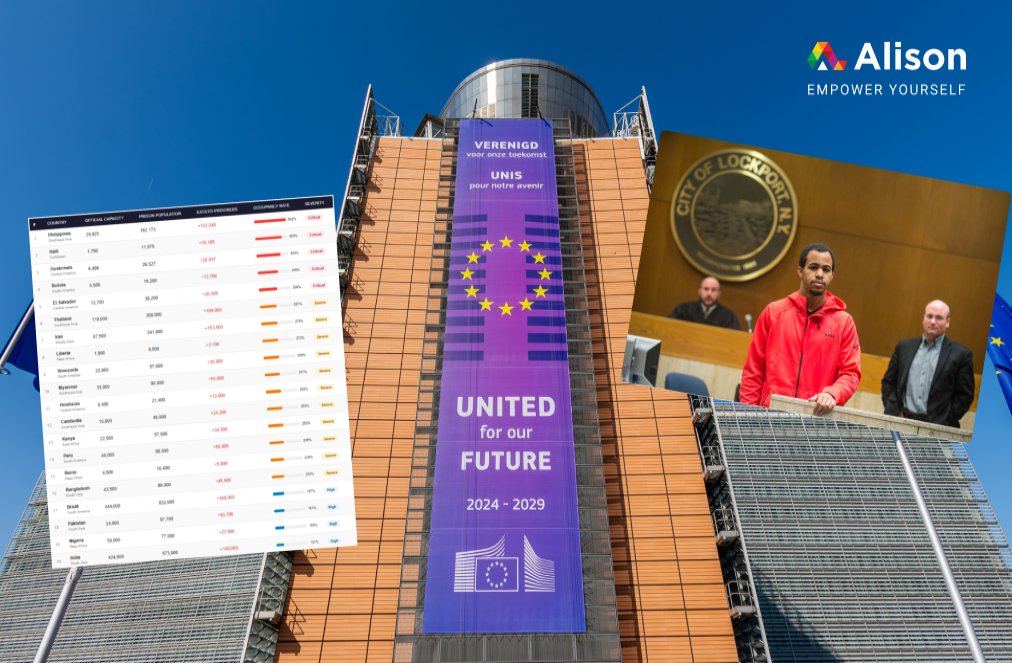
The proposal addresses two interconnected challenges facing European justice systems: prison overcrowding and the difficulty of reducing repeat offending. According to the Council of Europe's 2025 Annual Penal Statistics, 14 European prison systems have more inmates than available places, with nine experiencing severe overcrowding. The paper argues that, in appropriate circumstances, court-directed education could help individuals develop employable skills, improve their digital literacy, and build the confidence necessary to reintegrate into society.
A Decade of Education-Driven Justice Reform
The concept originated in 2016, when a court in Lockport, New York, incorporated Alison's accredited online courses into the sentence of a young non-violent offender, allowing him to complete structured educational programmes instead of serving a custodial sentence.
Working with Judge William J. Watson and adult education specialists at Orleans/Niagara BOCES, Feerick helped demonstrate how online learning could be incorporated into judicial sentencing while allowing progress to be monitored and educational achievements to be verified.
The individual, Dylan Lewis, completed the required courses and avoided imprisonment. According to the policy paper, he subsequently rebuilt his life, started a family, and remained out of further criminal trouble.
The approach has since developed beyond individual court cases.
In August 2025, Alison entered into a four-year partnership supporting His Majesty’s Prison and Probation Service (HMPPS) in England and Wales through its Unpaid Work programme. The initiative provides more than 47,000 offenders annually with access to professional and personal development courses, supporting education, training, and employment objectives.
Together, these experiences provide a foundation for exploring how structured digital education could be incorporated more widely into justice systems.
Five Recommendations for European Action
Rather than recommending immediate changes to sentencing legislation, the paper proposes a carefully evaluated European initiative involving willing Member States.
Its five principal recommendations call for:
A European Working Group on Digital Learning and Justice to bring together judicial authorities, probation services, education providers, researchers, and policymakers.
A European Feasibility Study to examine international experience, legal compatibility, and the practical considerations involved in court-directed learning.
A Multi-Member State Pilot Programme to test the approach across different European legal systems and sentencing frameworks.
An Independent Evaluation to assess educational achievement, employability, cost-effectiveness, sentencing compliance, and longer-term reoffending outcomes.
European Guidance on Good Practice to help Member States share effective approaches if the evidence supports wider adoption.
The paper recognises that sentencing decisions remain the responsibility of individual EU Member States. Its recommendations therefore focus on European cooperation, research, and evidence gathering, while preserving national legal frameworks and judicial discretion.
The proposed approach would complement existing sentencing options rather than replace imprisonment, particularly where custody is necessary for public protection.
Making Rehabilitation Part of Sentencing
A central argument of the paper is that the effectiveness of sentencing should be considered not only in terms of compliance with judicial requirements, but also in terms of an individual's preparedness to lead a productive life after completing their sentence.
Accredited digital learning offers opportunities to develop recognised skills while allowing courts and probation services to monitor progress, verify course completion, and tailor educational pathways to individual needs.
It can also introduce individuals who have experienced educational disadvantage to the possibilities of lifelong learning, potentially encouraging continued skills development beyond their involvement with the justice system.
The proposal also seeks to connect criminal justice reform with the European Union's wider priorities around digital skills, lifelong learning, and social inclusion.
The policy paper is intended as a contribution to European policy discussion, drawing on Feerick's experience working with courts, probation services, and legislators. It does not represent an adopted European Commission policy or an agreed change to sentencing frameworks.
Through its Alison for Justice initiative, including its work on reducing recidivism through education, Alison continues to explore how accessible education can support rehabilitation, employment opportunities, and successful reintegration into society.
Ends
About Alison
Alison is a global leader in free online learning and skills development. With over 50 million registered Learners across 193 countries (as of October 2025), Alison empowers individuals, communities, and organisations to upskill quickly and effectively – at zero cost.
The Alison platform provides immediate access to over 6,000 free, CPD-accredited courses, covering essential areas such as Artificial Intelligence, Data Science, Cybersecurity, Digital Marketing, Project Management, Business Operations, Healthcare and Sustainability. Courses are created by a mix of independent experts and global leaders, including IBM, Stanford and Microsoft.
For organisations, Alison offers a Free Learning Management System (LMS) that enables unlimited Learners to access thousands of courses with no upfront cost. A premium version with advanced analytics and customisation is also available. Alison's offering includes a full suite of assessments and psychometric tools, including a Workplace Personality Assessment, Mental Health & Wellbeing Assessment, English Language Proficiency Test, as well as Numerical, Verbal, and Abstract Reasoning tests.
To further support career development, Learners also gain access to a Career Guide, a Resumé Builder, and the ability to study offline through the Alison App. The platform is also expanding its reach with multilingual versions, starting with complete Spanish, French, and Hindi offerings — reaffirming its mission to make education accessible to anyone, anywhere.
Founded in 2007, Alison pioneered the concept of free, large-scale online learning and is recognised as the world’s first MOOC (Massive Open Online Course) platform. Today, its mission continues: to break down barriers to learning, helping people gain skills, build confidence, and improve their lives — no matter where they live or what they earn.