








Advanced Chemistry: Introduction to Electrochemistry
Back To Advanced Chemistry: Introduction to Electrochemistry
Enrolled1.5-3 Hours
Save This Course For Later
 Certify Now
Certify Now
Confident you have the skills to certify without completing the course content?
![]() Advanced Level
Advanced Level

Advanced Chemistry: Introduction to Electrochemistry
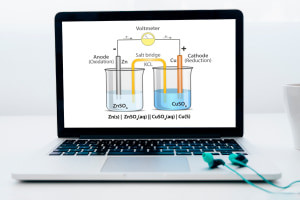
This free online advanced chemistry course covers electrolysis, electrode potential and the Nernst equation formula.
Save This Course For Later
Certify NowCertify Now
Confident you have the skills to certify without completing the course content?
- Enrolled
![]() Positive Ratings
Positive Ratings ![]()
- Avg. Duration1.5-3 Hours
![]()
- Available Languages (1)
![en]() English
English
![]()
 This course is
CPD-Accredited

 English


Confident you have the skills to certify without completing the course content?
Certify NowLearning Outcomes
In this free course, you will learn how to:
- Define ‘electrolysis’, ‘redox reactions’, ‘standard electrode potential’, ‘redox equilibrium’, ‘half-cell’ and ‘cells and batteries’
- Describe the electrolysis cell composition, redox reactions in the electrolysis cell, the galvanic cell components and the Nernst equation formula
- Calculate the amount of a substance produced during electrolysis, the Avogadro constant by an electrolytic method and the cell potential under non-standard conditions
- Explain how to write the oxidation-reduction reaction and the half-cell
- Summarise the galvanic cell components, primary and secondary batteries and their components
- Discuss hydrogen cell components and their chemistry
- Identify the voltage measured under standard conditions using a standard hydrogen electrodes
- List the advantages and limitations of hydrogen fuel cells and the various types of half-cells
Course Overview
About This Course
Course Description
Read More
Published by


Showcase Skills With A Certificate!
![]() Earn credentials that matter: Anyone can say they’re learning. A CPD-accredited Alison Certificate proves you followed through.
Earn credentials that matter: Anyone can say they’re learning. A CPD-accredited Alison Certificate proves you followed through.![]() Get an edge over others: Add your Certificate to your CV, LinkedIn, and Alison Profile to strengthen job applications and promotion opportunities.
Get an edge over others: Add your Certificate to your CV, LinkedIn, and Alison Profile to strengthen job applications and promotion opportunities.![]() Show you’re serious about growth: A Certificate signals initiative, commitment, and a willingness to keep learning; qualities employers actively look for.
Show you’re serious about growth: A Certificate signals initiative, commitment, and a willingness to keep learning; qualities employers actively look for.


Course Rating & Reviews
 -Positive Ratings
Reviews
Loading...
Loading...
Loading...
Loading...
Loading...
Loading...
View All Reviews![]()

Back to top
Back to course information

Download Courses And Learn Without Internet!
Use your iOS or Android devices to download Alison courses, and learn without internet on the Alison App.


Advertisement
Explore Related Courses

Interested In This Course For Your Team?
16,000 organisations use Alison for Business to upskill their teams


 Total XP:


