


Safety training is no longer a nice-to-have. For many roles, completing a foundational health and safety course is one of the fastest ways to demonstrate your understanding of hazard awareness, compliance, reporting, and safe working procedures. The real question is not whether you should upskill in health and safety, but where. Should you commit to a long university-style learning programme, or choose a faster, job-focused option that helps you act on safety requirements straight away?
This is where many professionals get stuck. Academic prestige and workplace compliance are not the same thing. If your goal is to support public health research or environmental policy, one route makes sense. If you need to run toolbox talks, document incidents, or improve site safety, another route is usually better. Alison makes the choice easier with free, flexible online learning that now empowers more than 50 million learners across thousands of subjects, with career support tools.
Step 1: Understand the Safety Professional’s Toolkit in a Health and Safety Fundamentals Course
The first thing to know is that not every health and safety course is trying to solve the same problem.
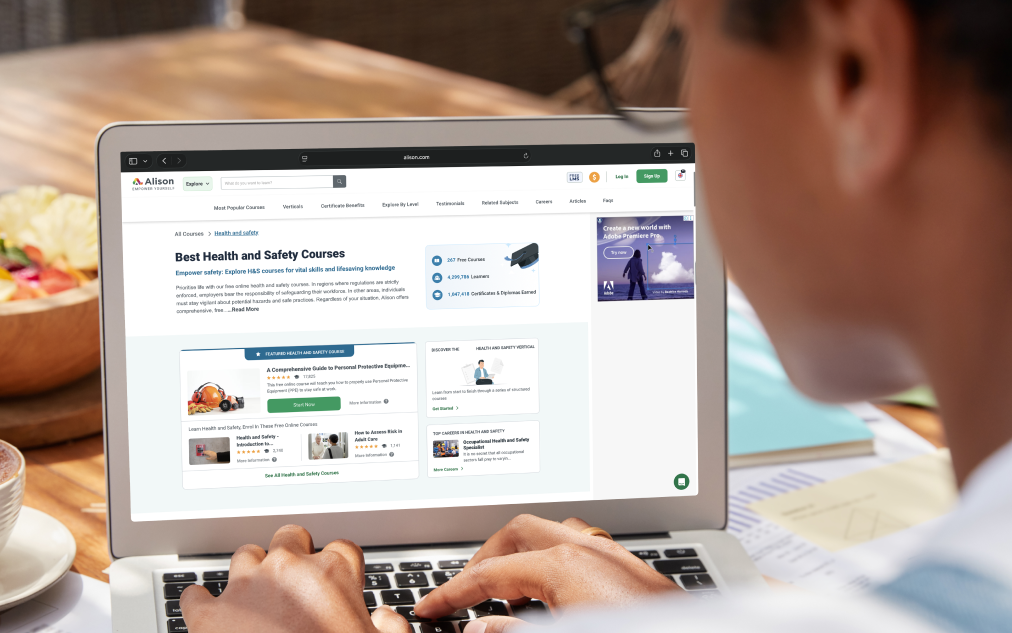
When you take a course on Alison, the emphasis is on speed, accessibility, and workplace application. Our Certificate and Diploma courses are designed for self-paced learning, making them a strong fit if you want to build practical skills quickly, and our Health and Safety courses can help you do just that. The Fundamentals of Health and Safety in the Workplace course focuses on the basic concepts and practices of workplace safety and health. In contrast, the ‘Core Principles of Occupational Health and Safety’ course explores international standards, workers’ rights, prevention systems, and continuous improvement. Both courses are free and will take you less than 3 hours to complete.
Coursera, by contrast, is often a better fit for learners who want longer-form study with a more academic or specialist angle. Its ‘Health, Safety, and Environmental (HSE) Engineering’ specialisation and related courses, such as ‘Environmental Health: The Foundation of Global Public Health’, lean more heavily into structured theory, risk frameworks, systems thinking, environmental health, and broader management concepts.
If your immediate need is a free health and safety basics course to improve procedures, audits, and day-to-day workplace safety, Alison is usually the more direct route. And if your priority is deeper academic framing or a multi-course specialisation, Coursera may suit you better.
A practical truth you will learn over time is this: learning pathways and needs evolve. Many people kick off their health and safety training with a basic course for immediate workplace use, then move on to broader management, environmental health, or research-led study once they are ready for the next step.
Step 2: Choose Your Career Pathway
Which learning platform to choose becomes clear once you connect your study choice to your career direction.
Alison: For Immediate Workplace Value
Alison is especially well-suited if you need to quickly demonstrate practical knowledge. Especially if you work as a site supervisor, warehouse manager, safety officer, operations staff, team lead, or consultant who needs a health and safety fundamentals course that translates directly into action on the job. Our Diploma in Workplace Safety and Health is structured around behaviour-based safety programmes and the creation of safety statements, giving you a broader practical foundation than a short introductory course alone.
Coursera: For Longer-Form, University-Style Progression
If you are seeking a longer-term educational programme, such as a multi-month specialisation, academic sequencing, or a university-adjacent learning experience, Coursera is a strong choice for you. You will find that their safety courses focus on risk assessment, emergency response, workplace regulations, and hazard identification, and specialisations such as HSE Engineering will expand your knowledge of accident causation models, regulatory evolution, and industrial safety.
Which is Better?
Choose Alison if you want:
- A free health and safety fundamentals course
- A compact online health and safety basics course
- Practical compliance knowledge you can use at work quickly
- Flexible self-paced study with direct certificate and diploma options
Choose Coursera if you want:
- Longer specialisations
- Public-health-style learning frameworks
- Academic learning experience
Step 3: Master the Compliance-First Health and Safety Workflow
In 2026, safety is not just about PPE, hazard signs, or emergency exits. It is also about documentation, process control, audit readiness, and clear legal compliance. A modern health and safety fundamentals course should help you understand how safety works in practice across procedures, records, and reporting.
This is an area where Alison stands out for many professional learners. Our Health and Safety Compliance for Legal Issues course is designed to help you interpret the language of international statutes and improve your ability to protect workers and support legal compliance. That makes it especially relevant for anyone moving beyond basic health and safety basics courses into real operational responsibility.
For example, you might begin with a free health and safety fundamentals course, then move on to more focused study of compliance, OSHA, or ISO systems, depending on the sector. Our extensive catalogue supports that learning progression through topic pages and specialist options such as OSHA and ISO 45001-related courses.
This “compliance-first” sequence is useful because it mirrors the real workflow inside many organisations:
- Identify hazards
- Assess and document risks
- Apply standards and safe procedures
- Train staff consistently
- Review performance and improve systems
For supervisors and safety coordinators, that workflow is often more valuable in the short term than a long academic programme. It is the difference between understanding safety theory and implementing safer routines tomorrow.
Step 4: Validate Your Skills with CPD Accreditation
Once you’ve completed a health and safety fundamentals course, the next question is, ‘How do I demonstrate my new skills to employers?’
This is why CPD matters. CPD stands for Continuing Professional Development. In simple terms, it shows that a course contributes to ongoing professional learning and meets recognised development standards. At Alison, our course creation process is accredited by the CPD UK, which means an Alison Certificate can count towards CPD hours, subject to an organisation’s own guidelines.
For employers, this matters because it shows that a candidate’s training is current, structured, and aligned with real-world workplace standards. For you, it means your effort doesn’t go unnoticed. When you complete a free health and safety basics course, you have clear proof of what you’ve learned and how you can apply it. You can add your Alison Certificate to your CV, LinkedIn profile, or portfolio to show that you take workplace safety seriously and are actively building job-ready skills. It’s a simple way to stand out, especially in roles where safety knowledge is essential.
That makes CPD-accredited learning especially useful for professionals who want practical proof of progress without stepping away from work for months.
Alison vs Coursera: Which Platform Wins?
There is no single winner because everyone’s learning goals are different. If you want a fast, practical, job-relevant health and safety fundamentals course, Alison is the stronger choice. Our platform is built for flexible, self-paced learning, offers free access to course content, and empowers you through short Certificate courses, broader Diploma courses, and CPD-accredited learning that is easy to apply in real workplaces.
If you want a slower, more academic pathway with specialist framing around environmental health, HSE systems, or public health, Coursera may be the better fit. Their catalogue is well-suited to professionals who want a longer, theory-driven progression.
For many people, though, the smartest move is to start with the training that solves today’s problem. If you need workplace-ready knowledge now, a health and safety fundamentals course on Alison can help you build confidence quickly, strengthen compliance habits, and earn a certificate that supports your professional development. Then, later, you can always expand into more advanced or research-led study.