



Steve was an ASE (automotive service excellence) certified master automotive technician for over 35 Years. Back in the day, he was the 'go to' guy for vehicles that no one else could fix, as well as a shop foreman and instructor of fellow technicians. After 26 years specialising in diagnosing electr

By the end of this course, you will be able to:
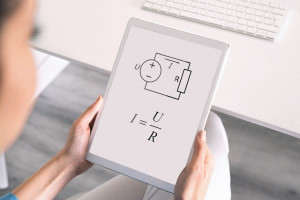
- Define at least five of the basic electrical terms presented in the course
- List the three Ohm's law formulas
- State the four series circuit rules
- Compute the missing voltage, current or resistance for Ohm's law math examples
- List the three power formulas
- Solve series circuit Ohm's law math problems
- Identify components in series in a demo circuit

By the end of this course, you will be able to:
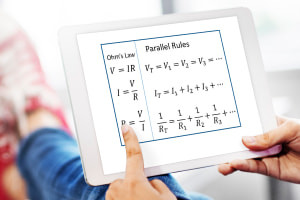
- State the four parallel circuit rules
- Describe the differences between parallel and series circuits
- Solve for total resistance in a parallel circuit using the parallel resistance formulas
- Identify when and when not to use parallel resistance calculation shortcuts
- List the three Ohm’s Law formulas and three power formulas
- Recognize when to use math or a parallel circuit rule when evaluating parallel math problems
- Select to find the missing voltage, current or resistance values in Ohm's Law parallel circuit math examples
- Identify components in parallel in a demo circuit

By the end of this course, you will be able to:
- State the four series circuit rules
- Recall the four parallel circuit rules
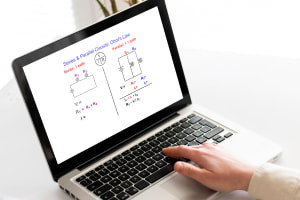
- Describe the differences between series circuits, parallel circuits and series parallel circuits
- Solve for total resistance in series parallel circuits using the series and parallel resistance formulas
- List the three Ohm’s Law formulas and three power formulas
- Recognize when to use math or a series or parallel circuit rule when evaluating series parallel math problems
- Arrange to find the missing voltage, current or resistance values in Ohm's Law series parallel circuit math examples
- Identify components in parallel in a demo circuit

By the end of this course, you will be able to:
- Define ‘voltage’, ‘current’ and ‘resistance’
- State what every basic electrical circuit needs to operate
- Describe the four types of faults that can affect electrical circuits
- Explain the differences between series circuits and parallel circuits
- Label the expected voltage measurements on voltmeter worksheets
- Recognize how schematics can be drawn differently but still be equivalent electrically
- Analyze automotive schematic diagrams to determine what parts of a faulty circuit are working based on the condition
- Explain the process of elimination approach to diagnosing electrical faults

By the end of this course, you will be able to:
- State the purpose of the starting system
- Describe the main parts of the starter motor
- Label expected voltage areas by highlighting schematics using multiple colors
- Identify starting system components on an electrical schematic
- Analyze starting system schematics to determine what parts of the circuit are good, based on the condition present
- Explain the process of elimination approach to diagnosing electrical faults

By the end of this course, you will be able to:

- Describe how diodes and transistors are used in automotive circuits and inside modules
- Discuss input and output circuits and what they do in automotive applications
- Define what a diode is, explain how to identify the terminals of the diode and how to test them
- Explain how temperature sensors operate and how the temperature sensor circuit can be diagnosed
- Explain how position sensors operate and the position sensor circuit can be diagnosed
- State why trouble codes set and explain how they only start the diagnostic process
- Identify the possible causes of a temp sensor circuit malfunction and describe how to narrow down the possible faults
- Identify the possible causes of a position sensor circuit malfunction and describe the process to pinpoint the cause


Frequently Asked Questions
Once you have completed your purchase, your Digital Certificate/Digital Diploma and Transcript can be downloaded from the Dashboard of your Alison Account.
I access Alison via my computer:
Expand the Your Completed Courses & Claimed Certificates widget in your dashboard as shown below:
You will then be able to download your Digital Certificate/Diploma and Transcript. 
I access Alison via my Mobile Browser:
Expand the Your Completed Courses & Claimed Certificates widget in your Dashboard as shown below:
You will then be able to download your Digital Certificate/Diploma and Transcript. 
I access Alison via App:
Open My Certificates in your Dashboard, as shown in the example below:

You will then be able to download your Digital Certificate/Diploma and Transcript.

Continuing Professional Development, or CPD, is the process of continually developing or maintaining your professional skills. CPD helps individuals focus on how they can become a more competent and effective professional. Due to our rigorous publishing review process, courses on Alison are now being accredited by CPD UK, an independent organisation. Accredited CPD training means the learning activity has reached the required Continuing Professional Development standards and benchmarks, and the learning value has been scrutinised to ensure integrity and quality. This CPD Certification Service provides recognised independent CPD accreditation compatible with global CPD requirements. This means a certificate from a course on Alison can now be used as part of your CPD requirements (please check with your organisation’s guidelines). You can find out more about Alison accreditation here.
Users can pay a nominal fee to automatically download Digital Certificates or purchase paper or framed Certificates that are shipped via mail. For a more detailed list of the costs, visit the Shop page.